
From the desk
Food Additives & E-Numbers: Safe or Scary?
Nutru
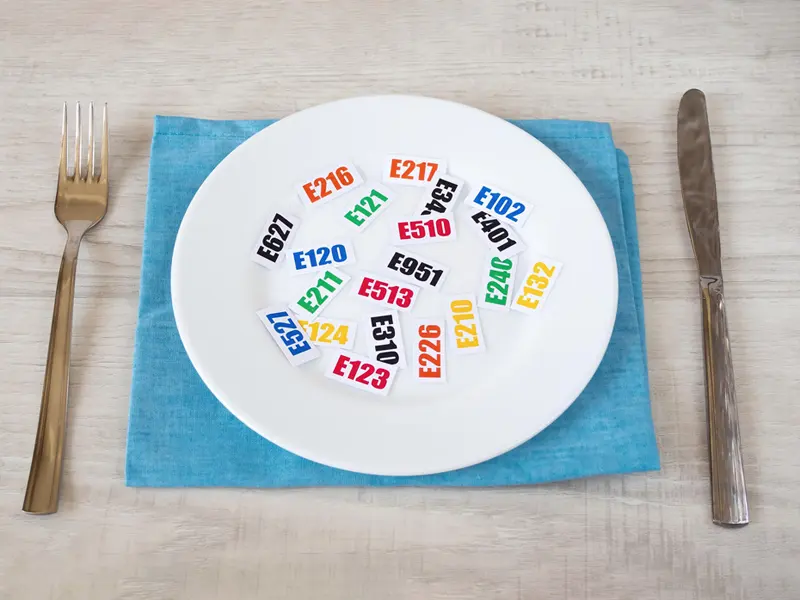
Have you ever noticed an E-number on a food label and wondered whether it is dangerous?
We live in an age of advanced technology, where we can easily research any information online and encounter both accurate and misleading content. But what do the labels E300, E621, or E250 on product packaging in supermarkets really represent?
Many people immediately think, "This must be something full of chemicals and harmful to health," but the truth is slightly different.
E-numbers are codes used in Europe to identify food additives — the letter "E" stands for Europe. This means that the additive has been scientifically tested, approved for use, and assigned a safe consumption level. In other words, everything with an E-number has passed safety evaluations.
What are "additives"? Additives are substances added to food to extend shelf life, enhance color, improve and intensify flavor, or stabilize texture (emulsifiers). They are not acutely toxic, but their long-term and frequent consumption is still a subject of scientific discussion.
It is important to note that not all additives are artificial — some are natural. For example, E300 is vitamin C, and E330 is citric acid found in lemons.
Not every E-number is harmful, but every E-number has been tested by scientific bodies such as the European Food Safety Authority (EFSA) and has a defined safe level of consumption.
However, even though they are generally safe, there are a few important considerations: quantity matters (even water can be harmful in excessive amounts); some individuals are sensitive (allergies, intolerances, or reactions to certain colorants); and not all E-numbers are "healthy" — safe does not necessarily mean beneficial.
Flavor enhancers or sweeteners may be approved and safe within certain limits, but that does not mean they are a good choice for everyday consumption. Some additives have already been banned — the list is continuously updated and unsafe substances are removed.
This is a myth: everything we eat is, in one way or another, made up of chemical compounds — even natural foods. The issue is not the E-number itself, but rather the level of food processing, the quantity consumed, and overall dietary habits.
Although E-numbers are safety-tested, certain additives are associated with potential side effects, especially when consumed frequently and in large amounts. These additives are not "toxic," but they are not ideal for frequent, everyday consumption. Attention should be paid to quantity, source (processed foods), and individual sensitivity.
E-numbers are a labeling system, not a warning sign. They indicate that ingredients have been tested. "Safe" means there is no direct risk within a certain quantity, but it does not necessarily mean the ingredient is beneficial or should be consumed regularly.
Instead of focusing on individual E-numbers, it is more important to consider the level of food processing, frequency of consumption, and overall dietary habits. The bigger issue is not the additives themselves, but their frequent intake through highly processed foods.
Although regulated and generally safe, informed and mindful choices are essential — because a single additive is rarely the problem, but habits make a significant difference.
Classification of E-numbers
- E100–199 – Colors
- E200–299 – Preservatives
- E300–399 – Antioxidants
- E400–499 – Stabilizers and emulsifiers
- E600–699 – Flavor enhancers
- E900+ – Sweeteners and others
Quick reference overview
🟢 Generally safe and often natural
| E300 | Vitamin C | Antioxidant | Natural, supports immunity |
| E330 | Citric acid | Antioxidant | Naturally found in fruits |
| E160a | Beta-carotene | Color | Provitamin A |
| E322 | Lecithin | Emulsifier | From eggs / soy |
| E440 | Pectin | Stabilizer | Natural plant fiber |
🟡 Controversial / require attention
| E621 | Monosodium glutamate | Flavor enhancer | Possible sensitivity |
| E250 | Sodium nitrite | Preservative | Linked to compounds in processed meat |
| E251–252 | Nitrates | Preservatives | Concern with frequent consumption |
| E951 | Aspartame | Sweetener | Subject of scientific debate |
| E950 | Acesulfame K | Sweetener | Common in diet drinks |
| E102 | Tartrazine | Color | Possible effects in children |
| E110, E122, E124 | Artificial colors | Colors | Linked to hyperactivity |