
From the desk
Most "Healthy" Snacks Are Ultra-Processed — Here's Why That Matters
Nutru
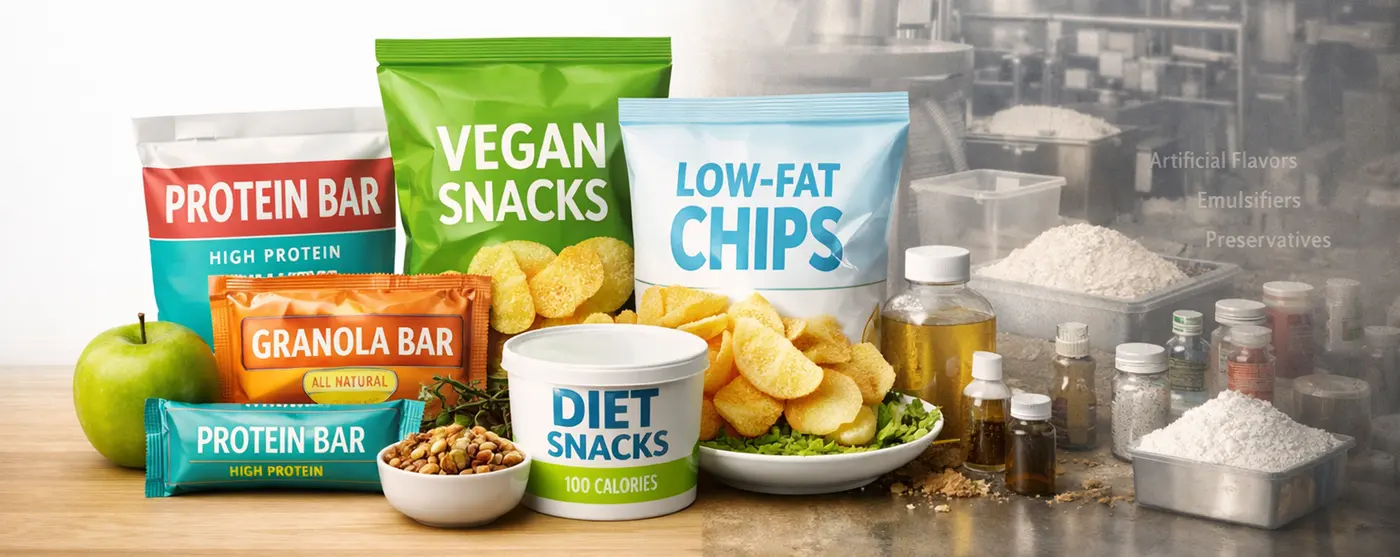
You reach for a granola bar, a rice cake, or a bag of veggie chips, feeling good about your choice. The packaging says "natural," "high protein," or "only 100 calories." But what's actually inside?
The reality is that many snacks marketed as healthy are ultra-processed foods — and that distinction matters more than any single nutrient on the label.
1. What does "ultra-processed" actually mean?
Ultra-processed foods (UPFs) are industrial formulations made mostly from substances extracted from foods — like refined starches, hydrogenated oils, added sugars, and protein isolates — combined with additives that enhance flavor, texture, color, and shelf life.
They're not just "processed" in the way that cooking or freezing is processing. UPFs are engineered products, designed in labs to be hyper-palatable, convenient, and long-lasting.
2. Why snacks are often the biggest offenders
The snack industry has mastered the art of health marketing. A product can be gluten-free, vegan, and "made with real fruit" — and still be ultra-processed. The front of the package tells one story; the ingredients list tells another.
Common "healthy" snacks that are often ultra-processed: protein bars, flavored rice cakes, veggie chips and straws, fruit-flavored gummies, granola and granola bars, low-fat or diet crackers.
3. Why does it matter beyond calories?
Research increasingly links high UPF consumption to a range of health concerns — not because of any single ingredient, but because of the overall pattern of eating heavily industrialized food.
Studies have associated frequent UPF consumption with increased risk of obesity and metabolic issues, poor gut health due to disruption of the microbiome, higher rates of anxiety and depression, cardiovascular disease, and even some cancers — though research is ongoing.
One key reason: UPFs are often stripped of fiber, micronutrients, and the food matrix that helps your body regulate hunger, blood sugar, and satiety. You eat more, absorb less nutrition, and your body's signals get disrupted.
4. The label trap
The packaging of ultra-processed snacks is designed to reassure. "No artificial colors." "Source of fiber." "Vegan." These claims can be technically true while the product is still heavily engineered.
Meanwhile, the ingredients list — which is where the real story lives — is often long, complex, and full of items the average person doesn't recognize.
The hidden problem: it's not about one ingredient
When people try to evaluate snacks, they often focus on a single nutrient: sugar, fat, calories, protein. But the ultra-processing framework is different — it's about the degree of industrial transformation the food has undergone, not just its nutrient profile.
A snack can have "less sugar" and still be ultra-processed. It can be "high in protein" and still be made from industrial isolates with a dozen additives. The nutrient focus keeps you looking at individual trees while missing the forest.
How to choose better snacks
- Read the ingredients list, not just the front of the pack
- Look for short ingredient lists with recognizable, whole foods
- Be skeptical of health claims — they don't equal nutritional quality
- Choose snacks close to their natural form: nuts, fruit, yogurt, eggs
- If you can't tell what something is made of, that's a signal
This doesn't mean you can never eat a granola bar. It means understanding what you're actually eating — and making that choice consciously.
The "healthy" label on a snack is marketing. The ingredients list is information. Learning to read the second one is one of the most powerful things you can do for your long-term health.